THE HOUSE OF RESEARCHERS Clinical research services
DEDICATED SERVICE
RCT Planning, Randomisation & Analysis
Support from sample size and allocation concealment to CTRI registration and analysis aligned with your trial objectives.
A COMMON INTERPRETATION ERROR
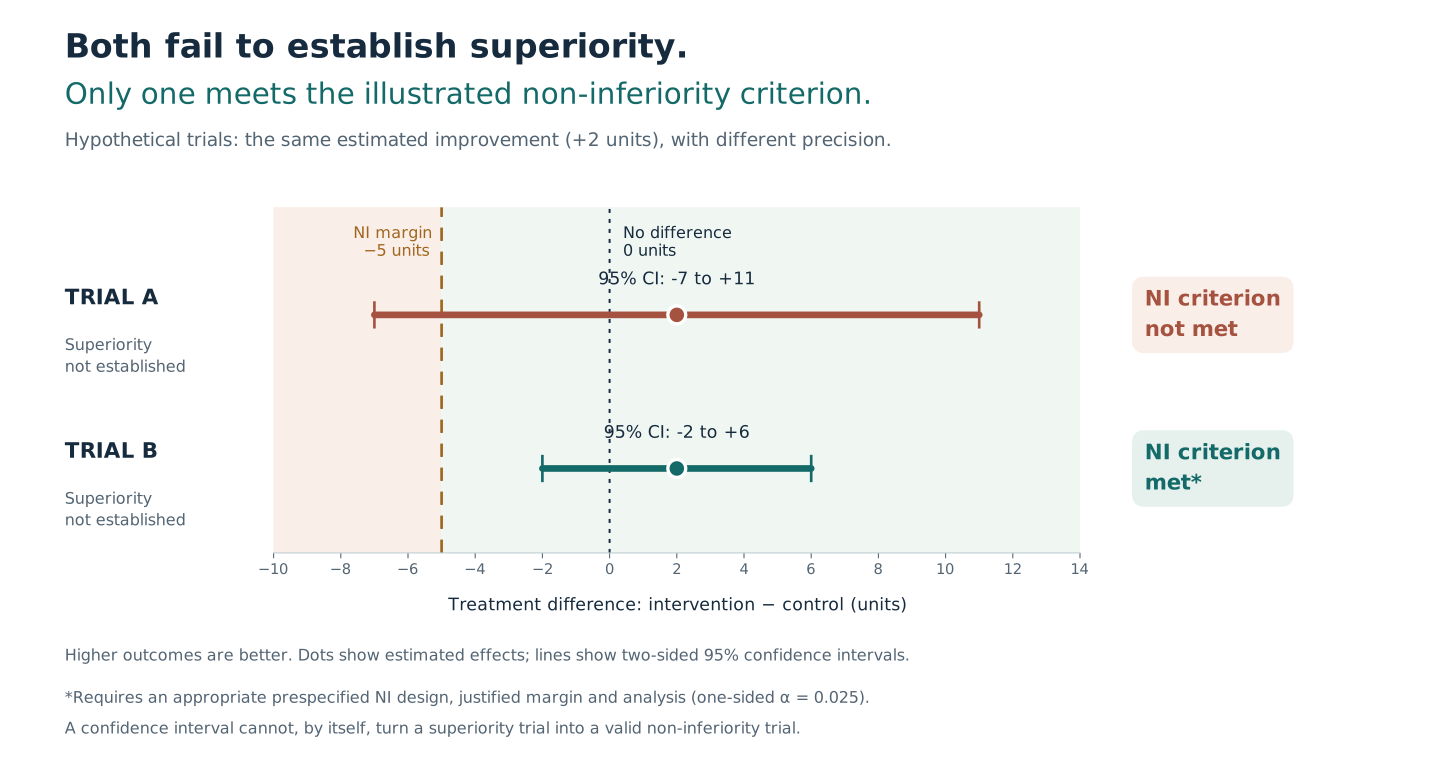
Non-significant superiority does not establish non-inferiority.
A result with p > 0.05 alone cannot show that treatments are equivalent or that one is non-inferior. The trial design, justified margin and confidence interval determine what can be concluded. 1
We help researchers understand the question their trial can answer and the conclusions their data support.
FROM PLANNING TO REPORTING
Practical support across the trial
01PLAN
Trial objectives & sample size
We calculate sample size for superiority, non-inferiority and equivalence objectives, using the primary outcome and planned analysis.
Document effect assumptions, variability or event rates, power, significance level and allocation ratio.
Review the clinical and statistical basis for the margin, where applicable.
Account for expected attrition and relevant design features; examine alternative assumptions.
Deliverable: a referenced calculation with formula, numerical substitution, assumptions and a protocol-ready explanation. 5
02ALLOCATE
Randomisation list generation
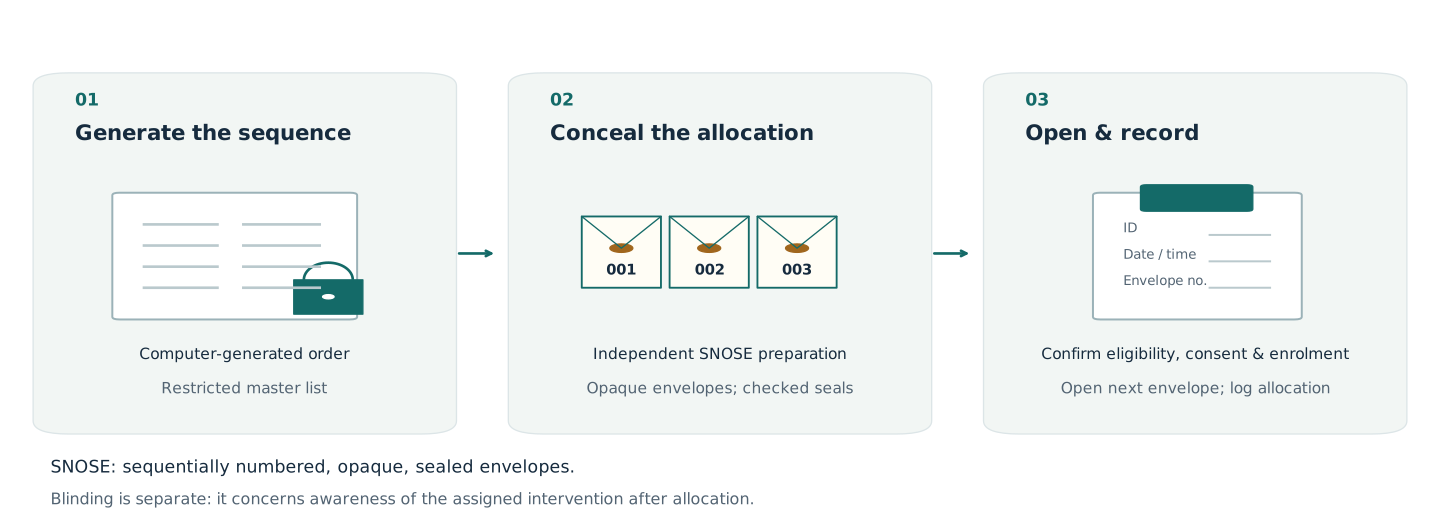
We generate computer-based simple, block or stratified randomisation lists, with the planned allocation ratio.
Provide reproducible code and documented generation settings.
Prepare allocation schedules and records for the authorised implementation team.
Define restricted access to the master list and concealed allocation details.
Deliverable: a randomisation schedule, reproducibility record and implementation instructions. 4, 5
03CONCEAL
SNOSE preparation & documentation
Preparation support for sequentially numbered, opaque, sealed envelopes (SNOSE) when this is the selected allocation-concealment method.
Prepare allocation slips, envelope labels and a preparation checklist.
Define independent preparation, opacity and seal checks, and secure custody.
Provide an opening procedure and allocation log for use after eligibility, consent and enrolment are confirmed.
Deliverable: SNOSE materials, a standard operating procedure and preparation/opening records. 4, 5
04REGISTER
CTRI registration support
We help prepare the Clinical Trials Registry–India (CTRI) record and check consistency with the approved protocol.
Organise trial details, outcomes, sample size, randomisation and concealment descriptions.
Check required approvals and contact-verification steps; support submission and responses to registry queries.
Assist with documented record updates and amendments.
Deliverable: a reviewed registration worksheet and support through the registry review process, under the authorised investigator/sponsor. 6
TWO DISTINCT TASKS
Generate the sequence. Protect the next allocation.
Sequence generation and allocation concealment are separate. Blinding concerns awareness of the assigned intervention after allocation. 4, 5
THE OBJECTIVE DETERMINES THE QUESTION
Superiority, non-inferiority & equivalence
SUPERIORITY
Evidence of benefit
Assess whether the intervention performs better than the comparator on the prespecified outcome.
NON-INFERIORITY
Rule out excessive loss
Assess whether a loss beyond a justified, prespecified margin can be ruled out.
EQUIVALENCE
Within both limits
Assess whether the confidence interval lies entirely within the prespecified lower and upper equivalence limits.
Hypotheses, margins and decision rules are specified in the protocol and statistical analysis plan. 1
Illustrative values only. The non-inferiority interpretation requires a suitable prospectively specified design, justified margin and analysis; it cannot be created by relabelling a non-significant superiority trial. 1
The same non-significant superiority finding can have different implications. In the example, Trial A cannot exclude an unacceptable loss. Trial B meets the illustrated non-inferiority criterion, provided the design and analysis support that claim.
DEFINE WHO IS ANALYSED AND WHY
ITT, modified ITT & per-protocol analysis
We align the analysis population, handling of treatment changes and missing outcomes with the intended treatment effect and the prespecified analysis plan. 2
ITT
Intention-to-treat
Analyse participants in their originally randomised groups regardless of adherence, with an appropriate plan for missing outcomes. 1, 2
mITT
Modified intention-to-treat
Use explicitly defined, justified restrictions to the randomised population. The label has no single standard definition; all exclusions and their reasons must be clear. 3
PP
Per-protocol
Analyse participants meeting prespecified adherence and protocol criteria, with careful consideration of the bias that exclusions can introduce. 1, 2
We examine disagreements between planned analyses and report how exclusions, missing data and protocol deviations affect interpretation. Appropriate sensitivity analyses assess robustness to the assumptions of the main analysis. 2
ANALYSIS YOU CAN FOLLOW
Transparent results. Reproducible outputs.
Our reporting connects the trial objective, analysis methods and conclusions.
Statistical analysis plan and documented analysis populations.
Primary and secondary outcome analyses, with treatment-effect estimates and confidence intervals.
Relevant safety summaries, supporting analyses and explanations of uncertainty.
Manuscript-ready tables, figures, statistical methods and results.
Reproducible R code and Quarto reporting files.
COMMON RESEARCHER CONCERNS
Interpretation without shortcuts
Non-significant results and claims of non-inferiority
A non-significant superiority test alone does not establish non-inferiority or equivalence. We assess the trial objective, margin and confidence interval, and explain when the result remains inconclusive. 1
Choosing a non-inferiority margin
We help document the clinical and statistical justification using relevant evidence and the intended treatment effect. The margin is specified prospectively; it should not be chosen to fit the observed result. 1, 2
Different ITT and PP conclusions
We investigate exclusions, adherence, missingness and differences in the question being answered. The report explains the disagreement and qualifies the conclusions accordingly. 2
Dropouts, crossover and treatment discontinuation
We distinguish missing outcomes from events that change the interpretation of an outcome. Methods and sensitivity analyses are selected to address the prespecified treatment effect. 2
A completed trial with an incomplete analysis plan
We review the available protocol, identify defensible analyses, and document departures from the original plan and their implications for interpretation. 1
Registration after recruitment has started
CTRI accepts prospective registration. Submitting a form or receiving an REF number before recruitment does not permit enrolment while the CTRI registration number is pending. 6